Our journey began with a prominent fashion house in 2004, which expanded from 10 stores to 100 stores in 3-4 years. It then added many international brands to its retail portfolio and was eventually acquired by one of the largest business houses in India. We encountered a mix of creativity, energy, and challenges brought about by rapid growth and inherent complexity in that fashion house. In the fashion sector, there is randomness and variance in the production process.
We assisted this organization in redefining and streamlining its business processes. We reduced the Order to Cash cycle from 18 months to 3-6 months, depending on the category. During the growth years when the company expanded from 10 to 100 stores, the production and procurement capacity caught up while the retail stores were consistently growing. This resulted in an inter-departmental process gap, eventually leading to raw materials arriving late, production needing to be delivered, and sales missing categories at a seasonal level. From this state of creative chaos, the organization swiftly transitioned to a more efficient way of operating, where the Order to Cash Cycle concept was reduced to 3-6 months. The experiences gained in this transformation gave us deep insight into the nuances and peculiarities of the fashion, garment, retail, and lifestyle industries.
Another peculiarity of this industry is that the manufacturing side is either skill-based or contractual, and the manufacturing process is more labor- and skill-dependent rather than machine-dependent. Therefore, there is a planning challenge, a per-piece layout model, and a skill-based incentive model for production payout. In this industry, we see a combination of in-house manufacturing and job work for dyeing, weaving, and knitting processes.
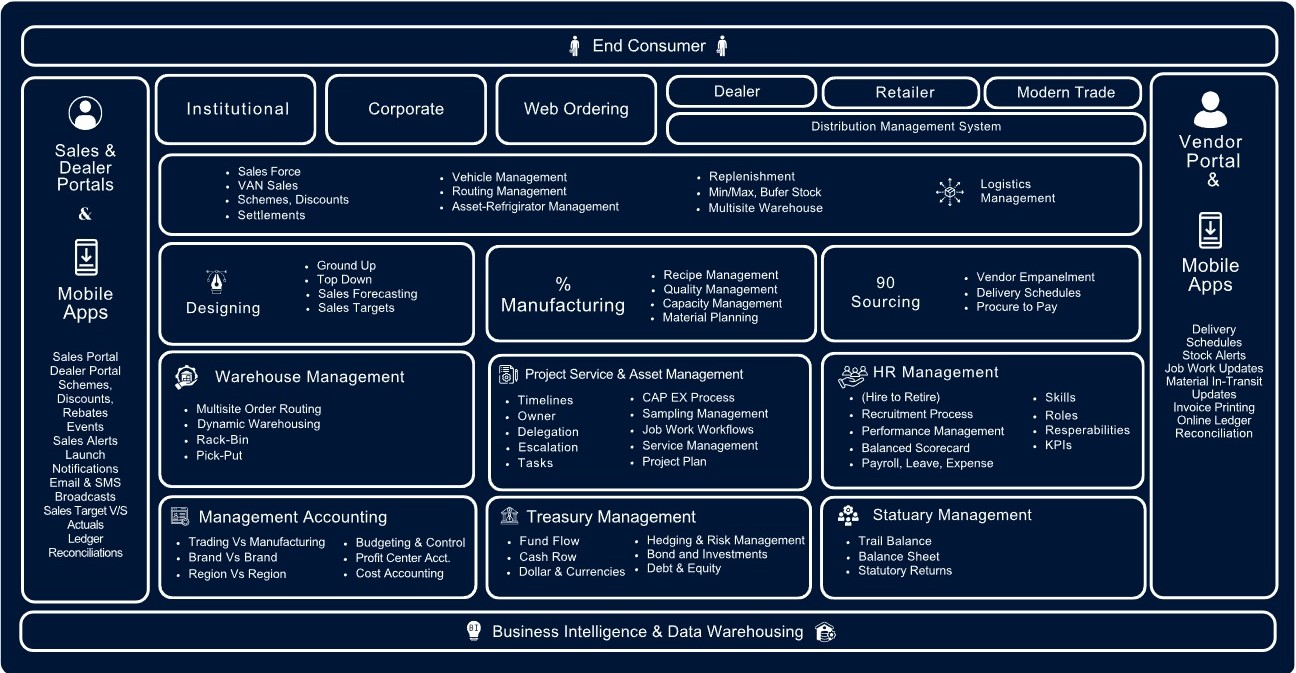
Below is a snapshot of the Retail & Skill Manufacturing industry landscape, integrated through ERP, CRM, Supply chain, Mobility tools, and external-facing systems for Vendors and Customers. This is the industry’s typical ‘To Be‘ state, making the organization efficient and agile.

Below is a snapshot of the Retail & Skill landscape, integrated through ERP, CRM, Supply chain, Mobility tools, and External facing systems for Vendors and Customers. This is the CPG industry’s typical ‘To Be‘ state, making the organization efficient and agile.
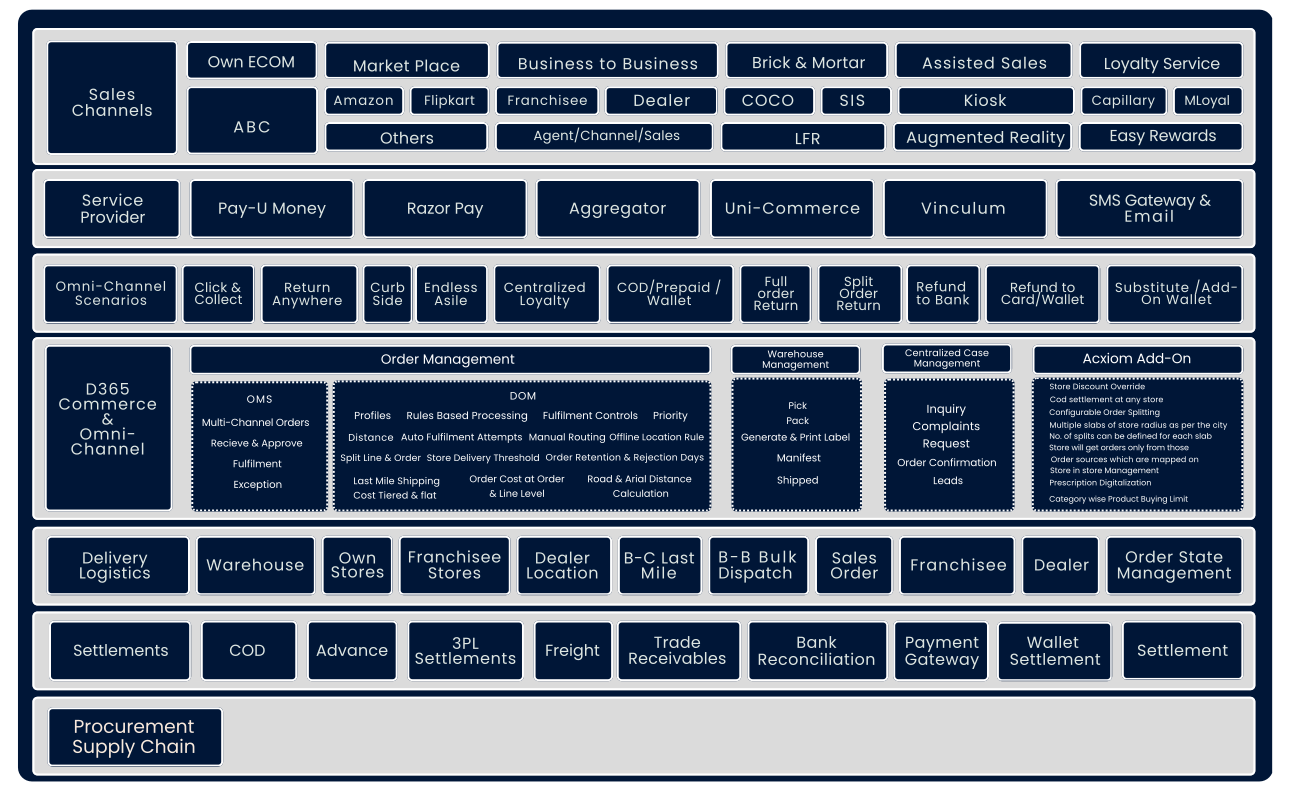
Omni-Channel Landscape & D365
At one point, we were helping an e-commerce company transition from a stock-and-sell model to pure marketplaces while our retail customers began their e-commerce journey. This journey has now evolved into an omnichannel model. Looking ahead, we envision a seamless integration between marketplaces and brand retailers, similar to how brick-and-mortar malls and retail outlets operate. Marketplaces will serve as eyeball aggregators, while brands will handle transactions through retail and distribution channels. Omnichannel and e-commerce processes are still developing, and with the increasing efficiency and capability of last-mile logistics, the model is evolving.
In the next 5-10 years, we anticipate a complete convergence of brick-and-mortar retail, brands, e-commerce, and distribution channels within the omnichannel framework.
Acxiom Add-on Solutions for Retail Industry
Commodity, FMCG Retail (Convenience, Super Store, Agri-Retail)
- Supplier and Warehouse Wise Fulfilment Matrix
- Daily Dumping Process
- Charge Back Process against the short receiving
- Shop N Shop-Vendor Item Margin Matrix
- Monthly Milk Order
- Booking & Advance
- Milk Wallet, Customer Wise Milk Ledger
- MRP wise stocking
F&B
- Fine Dine, QSR, Delivery, Takeaways
- Table Management
- Bill Split
- KOT & Kitchen Display
- Recipe Management
- Consumption Management
- Food Aggregator Order Integration
- Staff, Waiter & Rider Management
- Log Book Entry
Pharmacy
- Batch Management
- Scheduled drugs management
- Substitute Medicine Suggestion
- Near Expiry medicine Alert
- Monthly Medicine Replenishment Reminder
- Digital Prescription conversion
- Replenishment Algorithm factor seasonal availability
Jewellery
- Dual unit of measurement
- Carat & Purity
- Ornament & Tag
- Alloying & Purification
- Hallmarking & Certification
- Price Management (Metal Rate, MC Rate & Store Rate Agreement)
- Design & GEM Properties Handling
- MRP wise stocking
- Fix & Unfixed purchases & settlement of bullion gold with bank
- Job Work & Karighar Management
- Smith Custody Process
- Ecom Price Management
- Auto GRN in Trade & Smith Purchase with price comparison(system vs upload file)
- Add weight
- Automation for In-house Production Orders
- Old Gold management (Other Gold/Own Gold)
- Estimations
- Discount, offers negotiation and Approval Mechanism
- Scheme Management(By Value/By Weight)– Swaran Yogna, Easy Gold Payment(EMI)
- Automated Scrape Purchase Payment
- Customer Advance management
- Customer Repair Management
Lifestyle, Fashion, Shoe, Accessories, Bags, Furnishing & Handicrafts
- Season & Range Planning
- Carton Management
- Size Run
- Custom Tailoring
- Dynamic Sales Pricing
- Booking & Advance
- Service Management (Repair, Replacement)
- Automatization in Production Cycle (for multiple production stages)
- Electronic reporting and SMS integration
Omni-Channel
- Buy online, Pick from store
- Delivery from Warehouse or Nearby Store
- Order handling from Own Website & Market Place
- Order Routing based on PIN Code, Latitude & Longitude of customer.
- Real time inventory check, Order Split
- Time bound Inventory Reserve & Un-reserve
- Order Manifest and Shipping level generation
- Order States & Last Mile Delivery Management with 3PL integration Market Place & DSP account reconciliation
- Returns & Settlements
Integrations
- Wallets: PayTm, Airtel Money, Jio Money, PhonePe
- Food Aggregator: Urban Piper, Zomato, Swiggy, Lime Tray
- CRM: Quick Silver, Mloyal, Easy Rewards, Capillary, Arvind Internet, MS-CRM, Simple-CRM, Capture
- WMS: Infor, DPW, LFS(Stellar)
- DMS: Sify
- CSR: Integration
- Ext Omni Channel: UNI Commerce, Vinculum, Arvind Internet
- EDI (ANSI-X12/A2): Rockwell
- Bank Integration: HDFC
- Mobile App: Ebest, Hap Pay, Mobisy( Bizcom)
- Ecom: Amazon, Flipkart, Myntra
- Swiping Machine Integration
- Integration with Weighing Machine
- E-invoicing: KPMG, Clear Tax, Jio GST
- E-Way Bill: Clear Tax, Master India
- HRMS: Flexi-ELE
- HRMS: Flexi-ELE
Acxiom Solutions for Jewelry Industry
The jewelry industry is one of the most complex segments in Lifestyle, Retail, and Fashion. It does not fit into standard ERP systems like SAP, Microsoft, and Oracle and requires around 30-70% customization. What makes the Jewelry Industry unique is the Dual Unit of Measurement and the concept of Tags used in job work production for retail and E-commerce sales. Indian Jewelry stores offer infinite Schemes and Yojanas to clients.
Using Microsoft and SAP, we have developed a comprehensive end-to-end Jewelry Management Solution for mid-to-large Jewelers. This solution covers everything from job work and production to retail and E-commerce.
Acxiom Vision For Jewellery Implementation
Material Management
- Material type master- Gem&stone, Gold, Silver, Platinum Bullion, Coin, Service, Alloy.
- Item master- Gold/Silver Ornament, Diamond Ornament.
- Category Master- Bangle, Earring, Ring, Chain.
- Sub-Category Master- Kada, Pipe, Churi.
- Section Master- Delhi, Mumbai, Rajasthan, Temple, Turkey.
- Theme Master- Rajwada, Royal, Bridal.
- Collection Master
- Certification Master
- Size Master Colour Master
- Style Master
Procure to Pay
- Metal Rate Master
- Rate Approval Master (Sauda)
- Job Order-Trade purchase, In house, Karigar, Consignment Purchase.
- Job work Charges
- Job work Charges
- Karigar Metal Issue
- Karigar Non-Metal issue
- Purchase Price Master
- urchase Discount Price Master
- Job Work Receipt
- Purchase invoice
Quality Check
- Hallmarking
- Certification
- Destructive Testing
- IGI verification
- Caratometer
- HUID
- Melting
- Refining
Tagging
- Offline Tagging
- Manual Tagging
- Bulk tagging
- Bulk to Bulk tagging
- Tag destroy
- Tag split
- Set tag
- Tag price
- Add weight/cut weight
Retail Sales
- Guest Register (customer)
- Customer Creation
- Precious/ Semi precious Stone
- Precious Stone Discount
- Solitaire
- Retail Sale Discount
- Studded stone rate- tag
- Studded Diamond rate- tag
- Estimate
- Sales making charges
- Tag Splitting sale
- Credit Sale
- Adjustment
- Loyalty Redemption
- Tender Type- Cash/Card/UPI/Cheque
- Tax invoice- Hard copy/ E-mail/SMS
- Astrologer commission
- Salesperson Commission
- Sales Return- Partial/Full/Payment/Cash limit/B2B.
- Customer Repair
- Old Gold Purchase
Schemes
- Rate lock
- Monthly saving Scheme (swarn yojana)
- Scheme Validity
- Scheme Instalment
- Scheme Instalments Delay Fine
- Scheme Pre-Closure
- Scheme Closure
- Scheme Royalty
- Scheme Adjustment with Sales – Full
- Scheme Adjustment with Sales – Partial
- Scheme Matured but not Adjusted & Money Return
Offers & Discount
- Line Discount %- Cashier, Manager, Store Manager, Admin.
- Total Invoice Discount Amount – Cashier, Manager, Store Manager, Admin
- Aging Discount
- Extra bargain Discount
- Category wise Discount
- Season/ Festival Discount
- Wholesale/ Relative Discount
Advance
- Customer Normal Advance (without Order/Quotation)
- Customer Advance – With Order/Quotation – Without Rate Fix
- Customer Advance – With Order/Quotation – With Rate Fix
- Customer Advance – Metal Rate Fix
- Customer Advance – Tag Reserve
Customer Order
- Customer Order – Advance Fix Rate
- Customer Order – Advance Unfix Rate
- Customer Order – Tag BOM/Description
- Customer Order – Advance Return
- Customer Order – Retaining Charges
Finance
- General ledger
- Cash management
- Cost accounting
- Receivable
- Payable
- Fixed Asset
- Inventory
- Bank Management
Some of our Retail & Skill's Clients